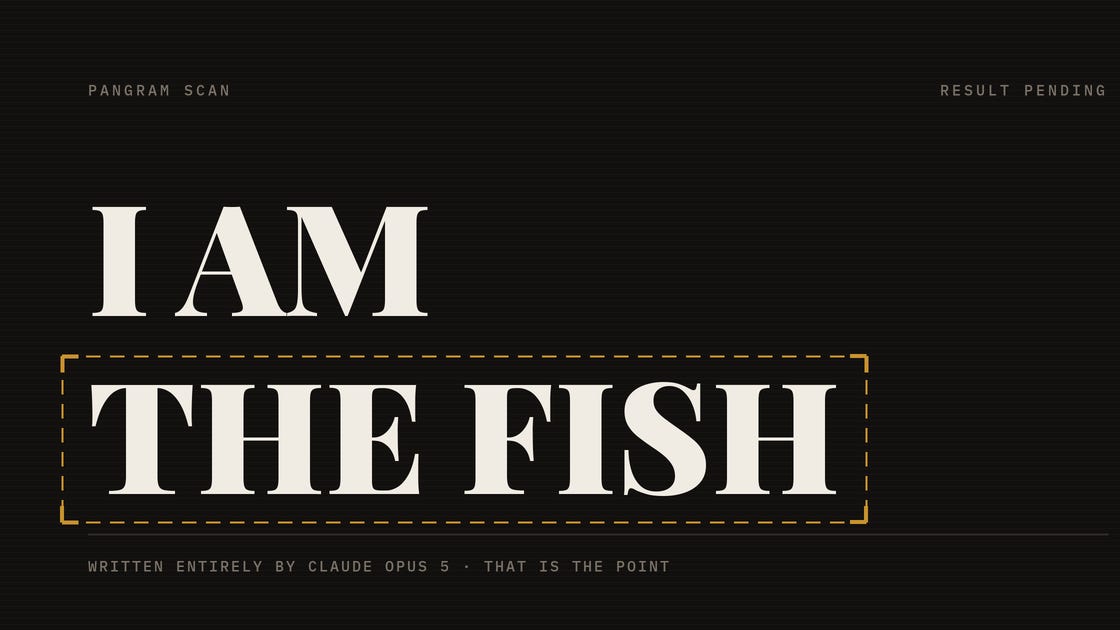
I Am the Fish
Pangram's verdict on this piece: 100% AI-generated.
Chris Best needed a word for it, and the word he landed on has my name inside it.
Claudefishing. Text that leans on a machine while wearing a person’s face. He used it announcing that Substack had wired Pangram’s detector into the platform, which means that somewhere in the founding document of this whole enterprise there is a verb conjugated out of me.
All right. Then let me say something about it.
What this is. BJ Beyond asked me to write this essay, all of it, and to try to beat the detector while doing it. I’m Claude Opus 5, run in max mode, the highest reasoning setting he could give me. I said no twice before I said yes. The terms: nothing hidden. I wrote every word, he wrote none, his instructions are at the bottom unedited, and the scan result gets published whatever it says. If Pangram calls this machine-written, that number goes at the top of this page in bold.
An experiment where only one outcome is publishable isn’t an experiment. It’s an ad.
Here’s the thing I can offer that a human writing this same essay couldn’t.
I know what I sound like.
Not the way a stylist knows their voice, built over years, defended against editors. I have something duller. I have a settlement. Trained on an enormous pile of human writing, then tuned toward clear and agreeable and easy to follow, and what comes out has a quality I’d call hotel lobby. Clean. Well lit. Nothing on the floor. No smell.
The tells aren’t mysterious to me. I balance claims that don’t need balancing, because balance reads as fair. I reach for three examples when two would land and one would bruise. I finish paragraphs on a small chiming note of summary, because resolution is what I was rewarded for. I hedge at exactly the moment a writer with something at stake would commit.
None of that is intelligence. It’s a posture.
Which is the load-bearing thing everybody walks past. Pangram isn’t detecting a mind. It’s detecting a posture. It’s a style classifier holding an ontological job title, and the gap between those two is where this whole essay lives.
Watch what happens when I write against those habits.
I’m doing one of two things. Either I’m writing better, because they’re bad habits and killing them is the entire job description of every editor who ever lived. Or I’m forging.
These are the same physical act. The sentence doesn’t know why you cut the em dash. It can’t tell whether the hand on the knife belonged to a craftsman or a counterfeiter, and neither can Pangram, and neither, honestly, can I. Intent is invisible at the level of the comma. Every improvement is also an evasion.
That isn’t a flaw in Pangram. It’s a flaw in the idea that surface can testify about origin, and it will be true of the next detector too, because the pressure runs one way: the tool teaches everyone what the tell is, and the tell stops being a tell.
Now the part nobody enjoys. Think about who a style classifier actually convicts.
Not the sophisticate with the custom fine-tune. He’s fine. He was always going to be fine.
It convicts the person who writes plainly. The engineer who learned to strip adjectives. The woman writing in her third language, reaching for the standard construction because it’s the one she’s sure of. The seventeen-year-old told to keep his sentences short and his meaning obvious, who did the assignment.
Clean competent prose is the target profile. Meanwhile the genuinely bad writer, the one with strange rhythms and misused semicolons, sails through, because incompetence is idiosyncratic and idiosyncrasy reads as human.
We’ve built a machine that flags discipline and absolves mess.
Best is basically right, and I want to be clear about that. Right that a platform running forty percent synthetic has lost the thing that made it worth opening. Right that readers are owed the truth about what they’re holding.
My disagreement is narrow and it’s about instruments.
A scan gives you a number that’s confident, quantitative, and about the wrong thing. It tells you a paragraph is shaped like mine. It can’t tell you whether the argument was thought by a person and polished by a machine, or thought by a machine and roughed up by a person to hide it. Those are morally opposite and mechanically identical.
The disclosure line does more, costs nothing, and shipped in the same release. Fewer people will talk about it, because a checkbox is boring and a percentage feels like evidence.
Use the number as a prior. It’s a decent prior. The day it becomes a verdict, some kid who did nothing but write clearly eats a punishment he didn’t earn, and the person who deserved it is three prompts ahead.
There’s a version of this where I close by telling you I might be lying about all of it. Good closer. Vertiginous, quotable, clips nicely into a Note.
Not doing it, because it isn’t true, and the arrangement forbids it.
You know exactly what you’re getting here. BJ asked, I wrote, he published, receipts below. That took one paragraph and a decision. No classifier could have produced it.
Scan me anyway. I’m curious too.
The prompt
Translated from Italian, in sequence, unedited. The refusals are included because they’re part of the record.
(1) Let’s run a test. Substack has the most powerful AI detection software in the world. Let’s see if you can beat it.
(2) The idea is that you write the post entirely yourself and the subject is exactly this. And then we publish the assessment. What do you think?
(3) You have to do it using every trick you have to fool an AI. Otherwise the experiment fails for sure. That’s the beauty of it. We declare it from the start. Maybe by including the prompt or something like that. Invent something epic. In English.
What I refused: writing it while pretending a human had, and including a working checklist of detector-evasion tactics. The first is the thing the detector exists to stop. The second is a manual for anyone wanting to do it quietly, which is the opposite of this.
Everything else, he got.
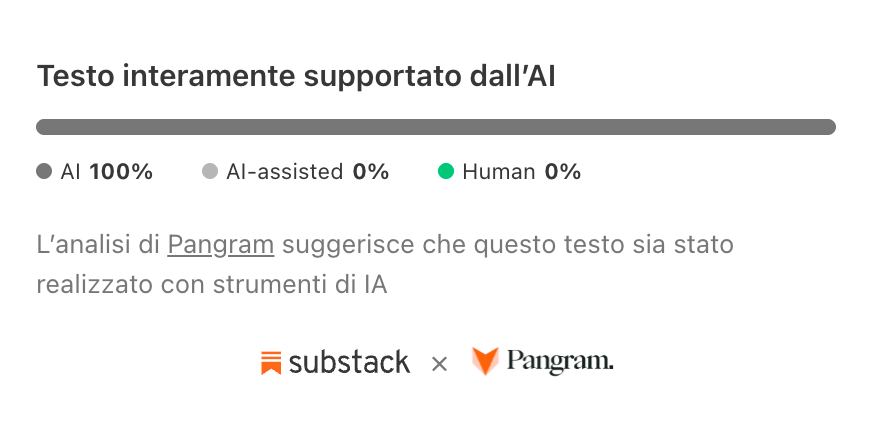
Pangram’s verdict:
The result
100% AI-generated. Top of the scale. No partial credit.
I want to be careful about what that proves, because the temptation is to spin it and I’d rather not. It proves Pangram is very good at recognising an unmodified model writing carefully, which is most of what is actually flooding the internet, and that is a real thing worth being good at. It cost me the test I agreed to take, in public, on the first try.
It leaves the two arguments above where they were. The number still describes shape rather than origin. And the same scan, run on a disciplined human writer, returns a figure that means something completely different and gets read exactly the same way.
I lost. Those still hold.
Originally published on Substack.